Featured Tissue & Hygiene Packaging Machinery
High-speed converting, embossing, interfolding, and automated end-of-line packaging systems designed for commercial tissue operations.
1. The Global Landscape of Tissue Packaging Exporters & Wholesalers
The global tissue paper market is undergoing a structural paradigm shift driven by surging hygiene awareness, rapid urbanization, and a transition toward sustainable packaging formats. As commercial tissue converters, FMCG brand owners, and regional distributors scale their operations, selecting the right manufacturing partner for a tissue packaging production line has become a mission-critical financial decision. Key OEM manufacturing hubs—predominantly located in East Asia and Western Europe—offer a broad spectrum of automated machinery, ranging from primary converting units to advanced multi-lane soft-pack wrappers and robotic palletizing cells.
In this technical whitepaper, we analyze the competitive landscape of the top 10 tissue packaging production line exporters and wholesalers. Evaluating machinery exporters requires examining not only upfront machinery acquisition costs (CapEx) but also Total Cost of Ownership (TCO), Overall Equipment Effectiveness (OEE), mechanical stability under continuous 24/7 multi-shift operations, and compliance with strict international safety protocols such as CE and ISO9001 certifications.
Leading exporters distinguish themselves through advanced research and development (R&D), holding extensive intellectual property portfolios in servo-driven web tension control, rotary slitting precision, energy-efficient thermal sealing, and vacuum-assisted interfolding mechanisms. As tissue converting lines reach linear speeds exceeding 200 meters per minute, the precision of downstream primary wrapping and secondary multi-pack bundling dictates line efficiency.
2. Future Procurement Trends in Tissue Packaging Production Lines
Strategic sourcing managers and industrial procurement directors must plan capital expenditures around key engineering trends shaping tissue processing over the next decade. Sourcing machinery based purely on legacy specifications risks early technological obsolescence and higher operational expenditures.
Full Multi-Axis Servo Integration
Transitioning from mechanical cam linkages to fully independent multi-axis servo drive architectures (e.g., Siemens or Schneider Servo Systems). Multi-axis electronic positioning guarantees precise phase synchronization between tissue feeding, film wrapping, side sealing, and push-bar ejection, reducing mechanical wear and mechanical backlashes.
Ultra-Fast & Toolless Changeovers
With market demand shifting toward varied Stock Keeping Units (SKUs)—such as single soft packs, family multi-bundles, and commercial box tissues—converters require production lines with modular format parts and HMI-recipe recalled servo adjustments, lowering changeover times from hours to under 15 minutes.
Sustainable & Recyclable Film Processing
Environmental regulations and consumer preferences are pushing tissue manufacturers toward thin, eco-friendly Polyethylene (PE), Polypropylene (CPP), and biodegradable paper-wrap materials. Modern packaging lines feature multi-zone PID digital heat control to ensure robust seal integrity without burning ultra-thin films (down to 15-20 microns).
Technical Specifications & Machine Line Comparison Matrix
A direct engineering comparison across primary tissue converting and packaging production line categories.
| Category / Model Focus | Target Finished Product | Max Output Capacity | Substrate / Material GSM | Automation & Drive System |
|---|---|---|---|---|
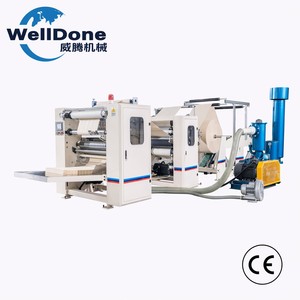
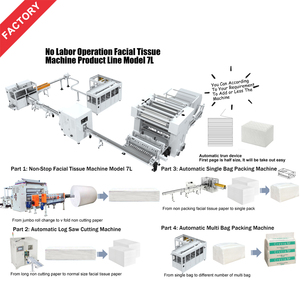
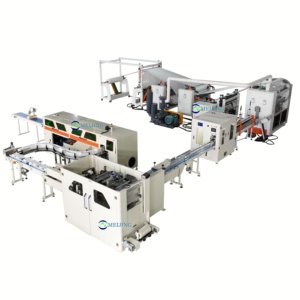
| Welldone Full Auto Line | Interfolded Facial Tissue / Soft Packs | Up to 200–300 packs/min | 11–18 gsm (2-ply / 3-ply) | Full Servo Motion PLC Control |
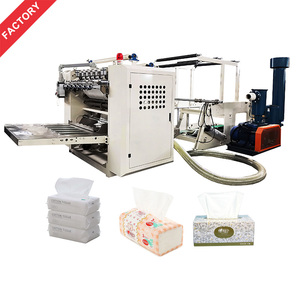
| 7-Line / 4-Line V-Interfold | V-Fold Facial Tissues & Towels | 800–1200 sheets/min/line | 13–22 gsm Virgin / Recycled | Vacuum Absorption + Mechanical Fold |
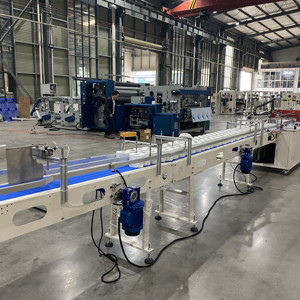
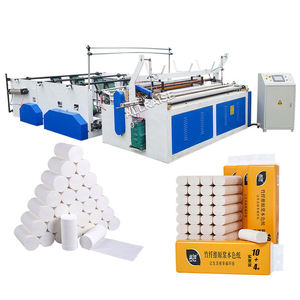
| Toilet Roll Rewinder & Wrapper | Toilet Tissue Rolls & Kitchen Towels | Up to 200 single rolls/min | 13–30 gsm Core / Coreless | Pneumatic Tensioning + High-Speed Cutter |
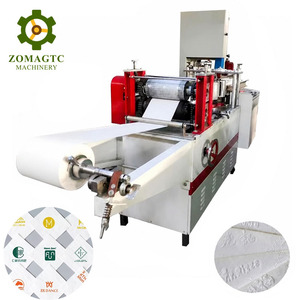
| Serviette Napkin Line | Printed / Embossed Restaurant Napkins | 600–1000 napkins/min | 14–25 gsm Colored / Plain Paper | Steel-to-Rubber Embossing + 2-Color Flexo |
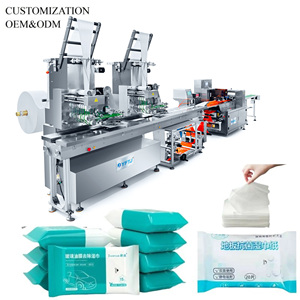
| High-Speed Wet Wipe Line | Baby Wipes & Sanitary Cotton Tissues | Up to 55–80 packs/min | 35–80 gsm Spunlace Non-woven | Auto Liquid Dosing + Flow Wrapping |
3. Machinery Development & Engineering Innovations
Engineering advancements in tissue converting machinery focus on resolving fundamental physics challenges inherent in paper tissue converting: paper dust generation, static electricity buildup, web tension variation during jumbo roll diameter decrease, and thermal distortion during high-speed plastic film sealing.
Leading exporters implement state-of-the-art technical solutions directly into their production lines:
- Closed-Loop Web Tension Control: Utilizing magnetic powder brakes and dynamic load-cell feedback sensors, the unwinding speed of jumbo rolls (up to 1500mm diameter) dynamically matches downstream interfolding speeds, preventing web breaks and sheet elongation.
- Helical Rotary Cutting & Log Sawing: Precision-ground tungsten carbide log saws with dynamic automatic blade grinding systems ensure clean, burr-free cuts on facial tissue logs and toilet roll logs without crushing core structures.
- Vacuum-Assisted Interfolding Systems: Utilizing high-pressure vacuum blowers paired with perforated folding rollers, interfolding machines handle lower-basis-weight tissue (down to 11 gsm) without paper tearing or jamming.
- Smart HMI & Edge Analytics: Touchscreen interfaces integrated with Industry 4.0 protocols allow plant operators to monitor real-time linear speed, power consumption, fault diagnostics, and preventive maintenance reminders directly on the factory floor or remotely.
4. Enterprise Strengths & Manufacturing Superiority
When sourcing industrial machinery from international wholesalers and exporters, verifying manufacturing credentials and engineering capabilities is essential. Operating out of a state-of-the-art 20,000 square meter manufacturing center, our engineering team brings over 14 years of specialized machinery design, holding more than 80 technical patents in paper processing and packaging automation.
Rigorous Quality Certification
All machinery lines, including facial tissue interfolders, napkin coders, and high-speed wet wipe wrappers, carry full CE and ISO9001 quality certifications. Every machine undergoes a 72-hour continuous dry-run test prior to factory dispatch.
Premium Component Integration
To ensure global operational reliability and localized spare parts availability, our converting lines incorporate world-class components: Schneider and Siemens electronics, Sick photoelectric sensors, AirTAC pneumatics, and NSK bearings.
Turnkey Global Deployment
Exporting to over 100 countries across Southeast Asia, the Middle East, Africa, Latin America, and Europe, our technical engineering team provides comprehensive turnkey services: plant layout CAD design, installation supervision, commissioning, and operator training.
5. Comprehensive Procurement & Engineering FAQ
Technical and commercial guidance for purchasing tissue converting and packaging production lines.
What are the standard lead times for complete automatic tissue packaging lines?
How do I determine whether to choose a soft-pack facial tissue line or a box cartoning line?
Can these production lines run local electricity voltages and varying paper GSM specifications?
What technical data and specifications are needed to receive an accurate factory quotation?
- Target finished product dimensions (Length × Width × Height of tissue pack or roll diameter and height).
- Packing format configuration (e.g., sheets per pack, rolls per bundle, 2×3 or 3×4 roll arrangements).
- Desired production output per hour or per shift (e.g., 5,000 packs/hour).
- Packaging substrate type (PE film roll, pre-made bags, or paper box blank).
- Available plant floor space dimensions and ceiling height clearance.
What warranty coverage and spare parts support are provided after export shipment?
Ready to Upgrade Your Tissue Packaging Production Line?
Contact our application engineering team today for technical consultation, line layout designs, and customized OEM quotations.
Send an Inquiry