Cooperative Robot Palletizer Systems for Tissue & Packaging Lines
Maximize line efficiency, eliminate ergonomic hazards, and optimize floor footprint with CE & ISO certified cobot palletizing solutions engineered by EuroFlow Tissue Machinery Co., Ltd.
20,000 m² ManufacturingIn-house machining & validation testing
Strategic Technology Guide
Why Global Procurement Leaders Choose a Cooperative Robot Palletizer
In modern tissue converting and hygiene product manufacturing plants, traditional end-of-line palletizing solutions often create severe throughput bottlenecks, require expansive safety enclosures, and inflate operational labor expenditures.
As tissue converting lines accelerate to speeds exceeding 200 packs per minute, manual case packing and pallet stacking become unsustainable. Ergonomic injuries, high labor turnover, and inconsistent pallet stack geometry frequently lead to warehouse damage and transit losses. Integrating a cooperative robot palletizer directly addresses these operational hurdles by bridging high-precision robotic automation with safe human-robot collaboration.
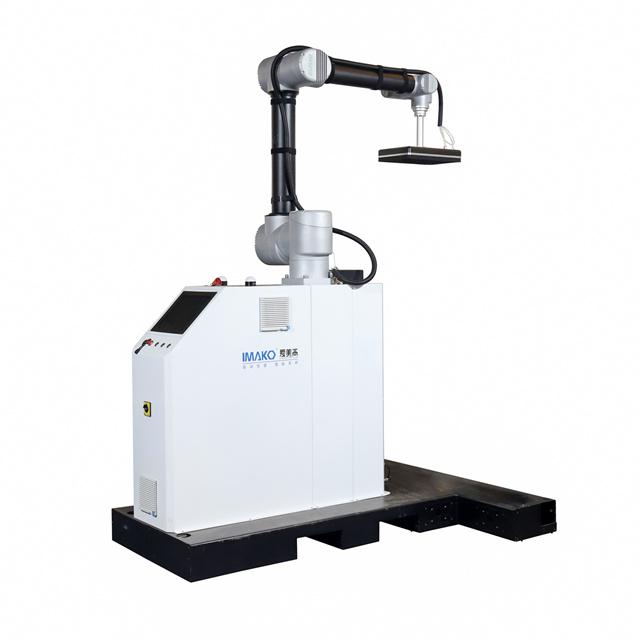
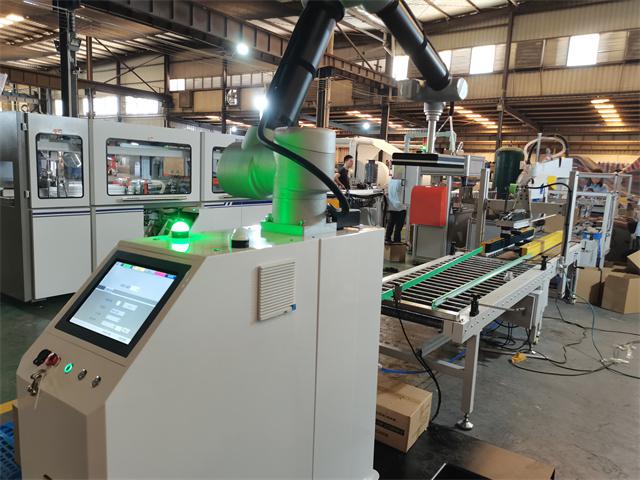
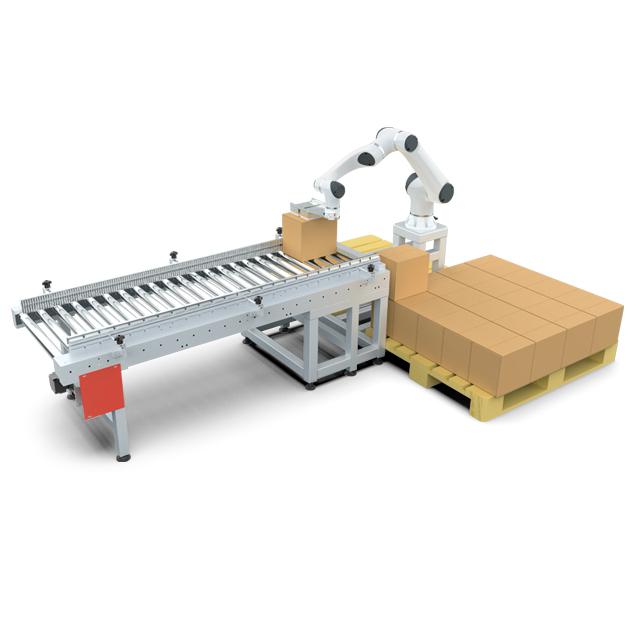
Engineered by EuroFlow Tissue Machinery Co., Ltd., our collaborative robot palletizing systems feature force-torque sensing joints, 3D laser safety scanners, and compact modular frames. Unlike conventional industrial articulated robots that demand 20 to 30 square meters of fenced area, a cooperative robot palletizer seamlessly integrates into existing conveyor lines within a minimal footprint of less than 6 square meters—without needing expensive perimeter safety guarding.
Future Procurement & Technology Trends in Cobot Palletizing (2025–2030)
Comprehensive market insights for factory directors and automation buyers preparing for next-generation end-of-line manufacturing systems.
Trend 01: AI Vision & Dynamic Patterning
AI Vision-Guided Pick & Place
Next-generation cooperative robot palletizer cells are abandoning fixed mechanical registers in favor of 3D vision perception systems. Integrated camera systems evaluate incoming soft packages, detect box rotation angles, and adjust gripper trajectories dynamically to eliminate jam-ups on misaligned conveyor lines.
Historically limited to lightweight applications, modern cobot architectures now routinely achieve 15kg to 30kg payloads with vertical reaches over 2.2 meters. This expansion empowers tissue plants to palletize dense corrugated cases and heavy bulk-packed diaper cartons without stepping up to high-risk industrial robots.
Procurement teams are shifting away from fixed, concrete-bolted robotic cells. Modern cooperative robot palletizers are built on integrated mobile skid platforms. Plant operators can relocate a palletizing unit between different tissue wrapping lines in under two hours with simple quick-disconnect power connections.
Why Partner with EuroFlow Tissue Machinery Co., Ltd.
Global leader in tissue paper machinery design, automated packaging systems, and collaborative robotic integration.
2011
Year Established
80+
Machine Patents
100+
Export Countries
20,000+
Square Meters Factory
100+
Expert Employees
1,000+
Global Client Installations
Manufacturing Expertise
Pioneering Industrial Automation Since 2011
EuroFlow Tissue Machinery Co., Ltd. is a specialized manufacturer and global supplier of high-speed tissue converting machinery, automatic packaging equipment, and end-of-line cooperative robot palletizing solutions. Spanning over 20,000 m² of modern manufacturing space with a dedicated workforce of 100+ skilled personnel, our company delivers turnkey automation systems to over 1,000 industrial clients across 100+ countries.
Holding over 80 machine patents, our engineering team adheres strictly to international CE and ISO quality management systems. Every cooperative robot palletizer, facial tissue bundler, and toilet roll packaging machine undergoes extensive Factory Acceptance Testing (FAT) using actual buyer samples prior to worldwide dispatch.
Leading international hygiene paper brands reliant on our automated converting and packaging equipment.
Expert Procurement Guidance
Cooperative Robot Palletizer Procurement FAQ
In-depth answers to key technical, financial, and operational questions commonly raised by global plant engineers and automation buyers.
What is a cooperative robot palletizer and how does it differ from a traditional palletizing robot?
A cooperative robot palletizer (cobot palletizer) is designed with integrated joint force sensors and power/force-limiting software algorithms that allow it to operate safely alongside human workers without heavy protective metal fencing. Traditional industrial palletizing robots are rigid, require large safety enclosures, and involve complex teach-pendant programming. In contrast, cobots offer a compact footprint (under 6 m²), drag-to-teach or software visual programming, and mobile skid mounting for fast line redeployment.
Can a cobot palletizer handle heavy tissue paper cartons and soft poly-wrapped bundles?
Yes. Modern cooperative robot palletizers engineered by EuroFlow Tissue Machinery Co., Ltd. accommodate payloads ranging from 10 kg up to 20 kg continuous industrial rating. We customize end-of-arm tooling (EOAT)—such as high-flow vacuum matrices for poly-wrapped bundles, servo mechanical grippers for corrugated master cases, and soft-touch foam cups for sensitive tissue products—ensuring stable pickup without package distortion.
What safety certifications and sensor systems are built into EuroFlow cobot palletizing cells?
All EuroFlow cooperative robot palletizer cells carry official CE and ISO certifications, meeting ISO 13849 PLd and ISO/TS 15066 safety requirements for collaborative robots. Our cells integrate multi-zone 2D/3D safety laser scanners. When an operator enters the outer warning zone, the cobot automatically slows to a safe speed; if the operator steps into the inner collaborative zone, force sensors prevent injury upon light contact.
What is the typical ROI period when upgrading to a cooperative robot palletizer?
Most hygiene tissue converters achieve full return on investment (ROI) within 9 to 14 months. Financial payback is accelerated through direct reduction of manual palletizing labor, elimination of repetitive strain workplace claims, 24/7 continuous shift capability, and reduced product damage caused by irregular manual stacking.
How easily can a cobot palletizer be integrated with existing tissue packaging lines?
EuroFlow cobot palletizers feature open industrial communication architecture (EtherNet/IP, PROFINET, Modbus TCP) powered by Siemens or Allen-Bradley PLCs. They connect seamlessly with upstream bundlers, case sealers, and wrapping machines. Operators select pre-configured pallet recipes from an intuitive touchscreen interface or create new stacking patterns within minutes.